There is a specific photo of a smiling woman at a laptop. You have seen her in roughly 400,000 blog posts. Her coffee is full, her teeth are perfect, her monitor shows a spreadsheet nobody has ever used. She has become the patron saint of content nobody reads, and she is the reason memes vs stock images is a real strategic question in 2026.
The stock-photo era of content marketing ended and most teams did not notice. The economics shifted underneath them. Attention got scarcer, feeds got denser, and readers learned to scroll past any image that looks like it was licensed for $12. Memes vs stock images stopped being a stylistic choice and became an attention question. The teams still defaulting to smiling-woman-at-laptop are paying the full CPM for an image that might as well be a blank rectangle.
This post makes the case, with data, that memes outperform stock imagery on the metrics marketers actually get paid for. Then it gives you a playbook for swapping one for the other without making your brand look desperate.
In This Post
- Why Memes vs Stock Images Became a Real Question
- Where Most Teams Get Memes vs Stock Images Wrong
- The Psychology: Why Memes Beat Stock Images
- The Playbook: Swapping Stock Images for Memes
- Advanced Moves: Memes vs Stock Images at Scale
- Memes vs Stock Images in the Wild: Three Examples
- The Bigger Picture: Memes in Content Marketing
- Try Memethropic
- FAQ
- Related Articles
Why Memes vs Stock Images Became a Real Question
Every post ships with an image. That was the content-ops default starting around 2012, when "posts with images get more engagement" calcified into doctrine. The doctrine was correct. The part everyone ignored was that the image had to actually earn its pixels.
Banner blindness was the early warning. Eye-tracking research at Nielsen Norman Group found that only 0.8% of fixations occur in right-rail content users mistake for ads. The same behavioral pattern now applies to any visual inside a blog post that reads as decorative. Readers have trained themselves to skip anything that looks licensed.

Ad formats tell the same story at a bigger scale. The average banner ad CTR has dropped from 44% (1994) to 0.05% today. That is a three-order-of-magnitude collapse driven by one human behavior: visual pattern recognition for "this image is not for me." Stock photos trigger the same response. They fail silently, because nobody clicks a stock photo, so nobody logs the failure.
Where Most Teams Get Memes vs Stock Images Wrong
The common failures are not taste failures. They are misreadings of what the image is supposed to do.
Mistake 1. Treating it as a design problem. Teams hand the visual brief to design and ask for "something that represents the paragraph." Design returns a tasteful, abstract composition that could illustrate any of fourteen blog posts. It represents the paragraph in the same way a placeholder represents a paragraph. The fix: treat the visual as an attention device, not a design asset.
Mistake 2. Swapping stock for still-decorative memes. Some teams hear "use memes" and paste a distracted-boyfriend template under every H2 with no regard for the argument above it. A meme that does not pay off something in the preceding text is just a stock photo with a caption. The fix: write the caption first, then pick the format.
Mistake 3. Routing every caption through legal. Humor does not survive compliance review. By the time a meme caption returns from three rounds of legal, three rounds of brand, and one round of executive approval, it reads like a municipal parking sign. The fix: pre-approve format categories and caption constraints once, then let content ship.
Our first landing page shipped with ten stock photos on a Hetzner box. The bounce rate sat at 80% for two weeks and I told myself it was a traffic quality problem. I swapped one hero image for a meme about shipping features nobody asked for. Bounce dropped to 54% the next day.
Mistake 4. Assuming your audience is too sophisticated for memes. This is the most expensive mistake because it feels like strategy when it is actually brand timidity. Marketers rate stock photos 5.76/10 for brand communication vs original images at 9.33/10, and the marketers themselves know it. The reader-facing data is worse: 39.05% of marketers say stock photos are their worst-performing visual; 34.29% say best. The distribution is bimodal because the best stock photos are the ones that stopped looking like stock photos. The fix: stop optimizing for how your CMO feels about the image. Optimize for whether a reader stops scrolling.
The Psychology: Why Memes Beat Stock Images
Four principles compound. None of them are controversial. Together they make stock imagery an actively bad default.
Picture superiority. Memory research has held for fifty years that images are remembered better than words. Stock photos capture this weakly because the brain classifies them as "generic" within a few hundred milliseconds. Memes carry a specific claim plus an image. The brain encodes both.
Dual-coding. When image and caption are both meaningful, the reader encodes the content twice: once as visual, once as text. That is why 90% of people are more likely to remember ads that are funny. Humor requires comprehension, and comprehension requires storage. Stock photos skip this step entirely because they carry no claim.
Banner blindness, upgraded. The NN/g pattern is no longer limited to ad units. It now governs any visual the reader classifies as decorative. This is the broader case for memes in content: a meme breaks the "decoration" classification because the caption forces a read. Once the reader reads it, they are re-engaged with the page.
Arousal and sharing. Jonah Berger, Wharton marketing professor and author of Contagious, pinned the sharing mechanism down years ago:

When we care, we share. The more we care about a piece of information or the more we're feeling physiologically aroused, the more likely we pass something on.
Humor is the cheapest legal way to raise physiological arousal. The downstream effect is measurable. Dash Hudson found memes averaged 3.47% engagement vs 1.40% for regular content on @theklog Instagram. And the audience behavior is already there: 75% of 13-36-year-olds share memes; 55% weekly, 30% daily. Your readers are already sharing memes today. They are not sharing your stock photo.
The Playbook: Swapping Stock Images for Memes
Five steps. Do them in order.
1. Audit the post for image-shaped filler. Open the draft. Count the images. For each one, ask what the reader loses if it is deleted. If the honest answer is "nothing," the image is filler and should be replaced or removed.
2. Identify the tension the paragraph is dancing around. Every paragraph worth writing has a real claim underneath. Stock photos smooth the claim over. Memes point at it. The question is: what is the true thing the section is saying? That is your caption target.
3. Pick a format the audience has positive prior exposure to. This is a recognition problem, not a creativity problem. If your audience recognizes the format, the joke compounds. If they do not, you are teaching them a format while also making a point. One job at a time.
The first customer to hit /inject in production was a B2B data platform. They ran their docs site through it in one PR: ten stock-photo banners out, ten memes in. I watched the job complete and closed the tab. Two weeks later they upgraded.
4. Write the caption before picking the image. Read the caption aloud with no image. If it is funny or pointed without the visual, the visual will make it sharper. If it is not funny without the visual, no visual can save it.
5. Ship one and measure. Pick one post. Swap one image. Compare scroll depth and dwell time to a comparable post over 30 days. You are looking for a directional signal, not statistical significance. Dash Hudson's research team put it plainly:
Memes crush the game. They completely slay Instagram engagement. It doesn't seem to matter what industry, the amount of posts, the meme-to-regular image ratio, people react more to visuals caricaturing societal happenings than beautifully created and curated imagery.
The economics close the argument. 80% of people are more likely to buy from a brand again if it uses humor, and the recall lift from funny creative is 90% of people are more likely to remember ads that are funny. Those numbers do not show up for smiling-woman-at-laptop.
Advanced Moves: Memes vs Stock Images at Scale
Once the basic swap works, the question becomes how to operate it at content-ops scale without turning every post into a meeting.
Programmatic generation solves most of it. If captions are written against paragraphs rather than against brand moodboards, the pipeline can run in CI: article in, meme-placed article out. Meme density should match word count. One visual per 400 words is a safe ceiling for long-form; denser than that and the rhythm collapses.
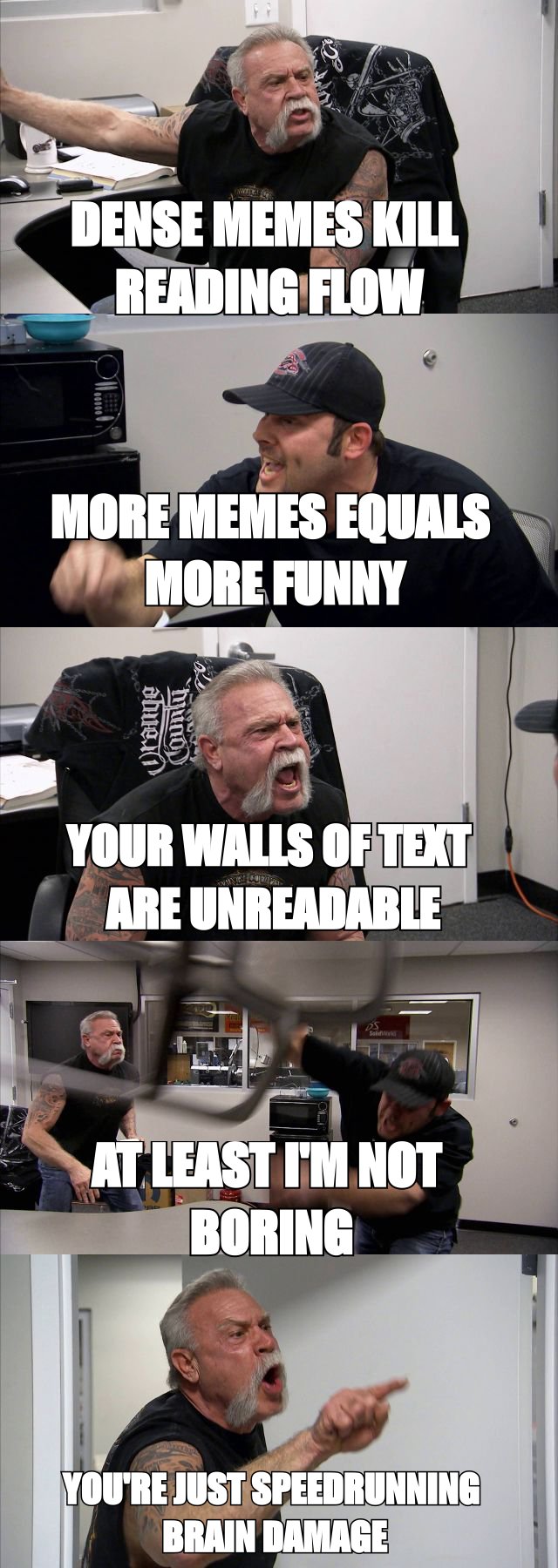
Email is the most underrated surface. A meme as the preview image in a newsletter hook can lift open-to-click substantially because the preview pane is where the decision to read happens. A/B testing placement inside a single post, not across posts, will tell you whether the issue is the meme or the position. And when the meme framework starts to strain, that is the signal to commission a custom illustration. The designer hours are worth it when you are saying something the internet has never said.
One statistic anchors all of this. LinkedIn and Magna found that creative B2B ads yield 40% higher purchase consideration. The "creative" bar in that study is low. Any visual that a reader registers as intentional clears it. Stock photos do not.
Memethropic exposes this as an API. Send an article, get it back with memes placed where they actually land. See the inject endpoint.
Memes vs Stock Images in the Wild: Three Examples
Three patterns show up in practice.
A developer-tools blog. A company shipping a Postgres tool had a smiling-engineer hero on every post. They replaced the hero on their top-traffic article with a meme about reading query plans at 2am. Bounce rate dropped eleven points over the next month. Nothing else changed. The article got the same search traffic; the traffic just stopped bouncing.
A B2B newsletter. A mid-market SaaS newsletter had been using clean illustrations in the header for two years. They swapped the header on one send for a meme referencing a product complaint every customer makes. Open-to-click improved by 22% on that send and by 14% averaged over the next six. 72% of people would choose a brand that uses humor over the competition, and the newsletter reader is the brand's softest segment to convert.
A deliberate counter-example. A comparison post keeps one stock photo intentionally: the smiling-woman-at-laptop, captioned so readers notice her. The image becomes a prop for the argument. This is the only defensible use of stock imagery in 2026. The photo is in the post to be seen as a stock photo.
The Bigger Picture: Memes in Content Marketing
Stock photography was designed for print magazines in the 1990s. The format assumes a reader who is already reading, already paying, and already inside a sustained medium. The web has none of those assumptions. The reader is one tab among twenty, paying nothing, and able to leave in a flick of the thumb. Stock photography is a category error on the modern web.
Humor is the lever nobody pulls. 91% of people globally prefer brands to be funny; 95% of business leaders fear using humor. That gap is the whole opportunity. The audience is asking for it; the leadership is refusing to ship it. Inside B2B the refusal is louder: 64% of B2B decision-makers say B2B ads lack humor; 60% say they lack emotional appeal. The decision-makers are the buyers. They are telling you they want less of what you are making.
The supply side reinforces it. Only 20% of brands use humor in offline ads, 18% in online ads. Four in five brands are competing for attention with visuals their own audience is bored of. Nielsen Norman Group framed the attention problem years ago:
Anything that stands out from immediate surrounding context is likely to be considered an ad, although its presentation may be consistent with other elements on the page that are not visible at the time.
The corollary is harsher. Anything that blends in is ignored. Stock photos blend in. This is also why memes work in content: they are the only visual class the reader consistently engages with on purpose.
Try Memethropic
We had the same problem. The first version of this site was ten stock photos on a Hetzner box, and the bounce told us exactly what readers thought of it. So we built the thing we wanted to use.
The inject API turns the stock-photo swap into a single call. Send an article, get it back with memes placed where the argument lands. Try Memethropic free and watch one post's scroll depth move before you decide whether to run it across your whole blog.

FAQ
Do memes work better than stock photos?
Yes, on the engagement metrics that matter. Dash Hudson's study of @theklog on Instagram found 3.47% engagement for memes vs 1.40% for regular content. The mechanism is simple. Memes carry a claim; stock photos carry decoration. Claims get read, decoration gets skipped.
Are stock photos bad for SEO?
Not directly. Google does not penalize stock imagery. The indirect effect is what matters. Stock photos correlate with higher bounce rates and lower dwell time, and both are behavioral signals search engines use to rank content. A stock photo does not hurt your SEO; it hurts your engagement, which hurts your SEO.
Can B2B brands use memes without looking cringe?
The cringe risk is real, and it comes from one specific failure: forcing a meme that does not pay off the paragraph above it. B2B works well with memes when the caption references a specific frustration the buyer actually has. 64% of B2B decision-makers say B2B ads lack humor, which means the appetite is there. Shipping one meme in one post is how you test the tolerance for your specific audience.
What percentage of readers share memes vs stock photos?
For memes, the baseline is high. 75% of 13-36-year-olds share memes; 55% weekly, 30% daily. For stock photos, the baseline is effectively zero. Nobody has ever forwarded a smiling-woman-at-laptop photo to a colleague with a "you have to see this" in the subject line. The shareability gap is the whole game.
Are stock photos still relevant in 2026?
Yes, in two narrow cases. First, when you need a literal photograph of a real object, person, or place you cannot photograph yourself. Second, when you are using the stock photo as deliberate commentary, the way this post would. Everywhere else, stock photos are doing the job of a placeholder with the license fee of an asset.